

Written by Erhan KahramanCommissioned Content
Written by Erhan KahramanCommissioned Content
The next crypto exchange war is fought at the checkout counter
CommissionedPublishedOct 28, 2026
A new financial gateway combines fiat transfers, onchain transactions, card spending and investment services as crypto platforms expand beyond trading.
Commissioned byGate
For years, crypto exchanges competed on listings, liquidity and fees. That contest has flattened out, and the new one is about who owns the rest of the user’s financial life: where the paycheck lands, where savings sit and what pays for lunch.
Exchanges are adding cards, fiat rails, stock trading and yield products. A trading venue people visit when markets move is a thin business, while an account people live in is a durable one.
Gate’s CEO, Dr. Han, framed the gap at Token2049 in Singapore with a deliberately mundane example. “Say you hold Nvidia stock and want a coffee,” he explained. “Today, you sell the shares, wait for settlement, withdraw to a bank, and only then pay.” Every step is friction, he stressed, and every step is a reason the money never leaves the investing world.
Managing fiat and digital assets through one account
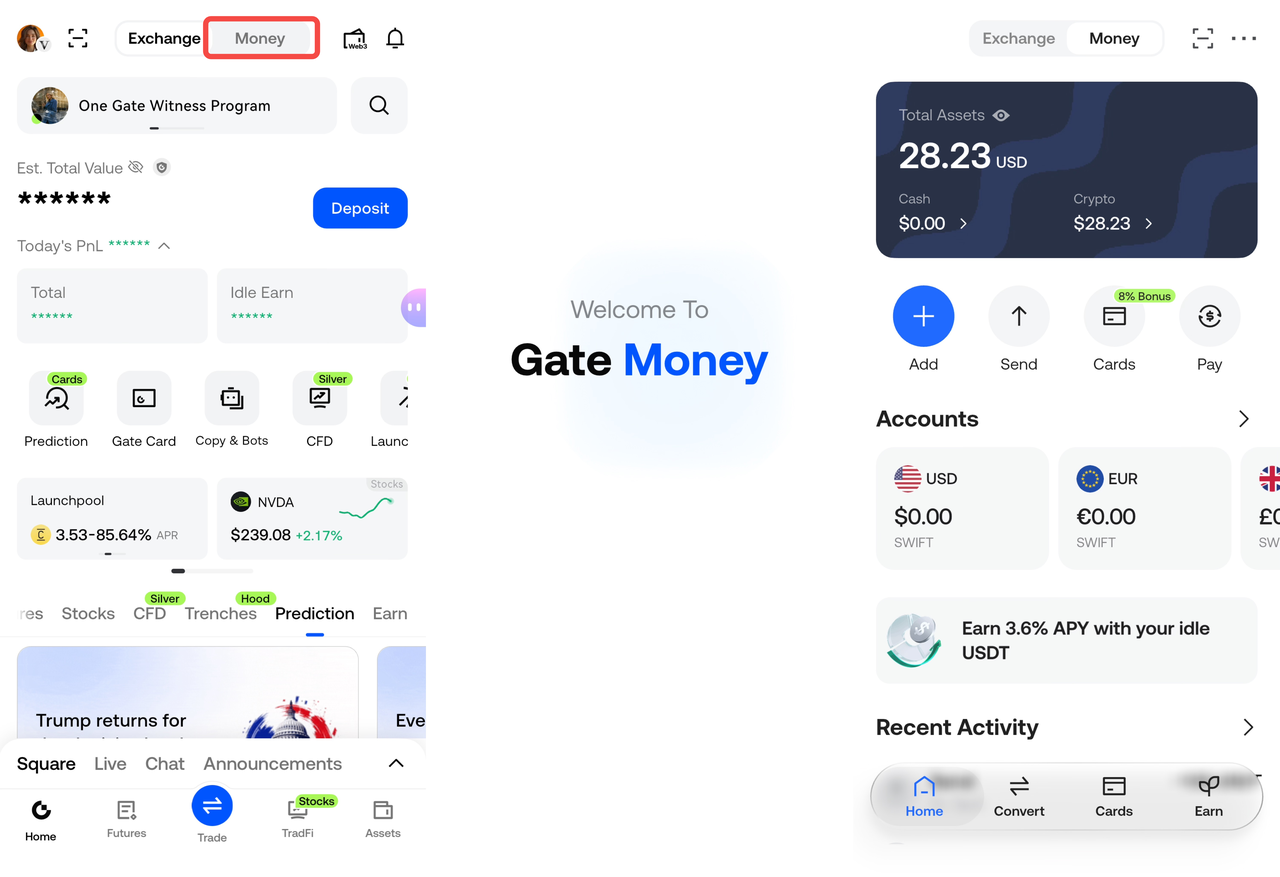
Gate Money is built to collapse that chain. Launched at Token2049, it puts fiat balances, digital assets, stocks, gold and a bank account in a user’s own name into one account, connected to a Visa-powered Gate Card. The ambition is that holdings are users’ spending power regardless of the form. It gives a combined view of balances and how funds move for supported currencies and assets. Users can manage fiat accounts independently by currency, deposit and withdraw money, and get or send digital assets over supported blockchain networks.
Source: Gate Money
Gate’s broader financial offering also includes access to stocks and other traditional instruments. Existing investment services form part of the expanded account ecosystem, which provides users with access to different asset classes and financial functions through Gate’s platform.
Extending account balances to payments and yield products
The Gate Card links balances in supported accounts to daily spending. Users can pay for online and in-store purchases using digital assets or fiat currencies. Apple Pay and Google Pay can be used for mobile payments. Cash withdrawals from ATMs and local QR-code payments add more ways to pay in certain countries and regions. Gate has also announced a partnership with Visa for a crypto-linked card, extending the payment side of Gate Money through the payment giant’s global network.
Asset conversion takes place through Convert, which supports exchanges between eligible currencies and digital assets. Gate Money also incorporates Earn, a range of optional yield and asset management products for users who choose to allocate funds beyond their immediate spending needs.
Eligible USDT balances can access products advertised at up to 3.6% APR without a lock-up period. The quoted rate is subject to the applicable product terms and does not represent a guaranteed return. Funds allocated to earning products remain subject to their respective eligibility and risk conditions.
As Gate expands its services beyond trading, transparency around customer assets also becomes relevant. Gate’s latest proof-of-reserves report shows total reserves of $8.688 billion and an overall reserve ratio of 118.49%. Bitcoin reserves reached 25,727 BTC, representing a 121.60% reserve ratio, while Ether reserves stood at 449,042 ETH, with a ratio of 123.78%.
Financial compliance infrastructure shapes regional availability
What money services Gate Money offers depends on local rules and the capabilities of participating providers. Gate works with international banks, payment firms, custody providers and clearing organizations to support transactions and manage assets in different markets.
Separate Gate entities hold regulatory authorizations for specific activities. In Malta, Gate Technology Ltd holds a Markets in Crypto-Assets (MiCA) crypto-asset service provider authorization and authorization to provide payment services under the country’s PSD2 framework. Gate Technology FZE holds a virtual asset service provider license from Dubai’s Virtual Assets Regulatory Authority (VARA), and Gate Information Pty Ltd is registered with AUSTRAC as a digital currency exchange provider in Australia.
In the US, Gate US holds 37 state-level money transmitter licenses, with services available across 47 states and territories. Gate Future has also obtained a US Introducing Broker (IB) qualification, extending the group’s regulatory footprint into derivatives-related brokerage activities.
The authorizations apply to their respective legal entities and permitted activities. Individual Gate Money functions, including named bank accounts, payment methods and financial products, remain subject to local availability and customer eligibility.
Gate serves more than 61 million users worldwide across its broader platform, although the figure does not represent the number eligible for Gate Money services. The October launch adds account-based fiat transfers, card spending and optional financial products to Gate’s existing trading infrastructure, with the scope of each service determined by the applicable jurisdiction and supporting financial institutions.
The next test for Gate Money is whether customers begin using the account for more than trading. As access to fiat transfers, payments and investment services expands, Gate is positioning its platform for a broader role in users’ financial activity, where receiving money, managing assets and paying for everyday purchases become part of the same experience.


Subscribe to daily byte-sized crypto news from Cointelegraph
This content is part of a paid partnership. The text below is a commissioned article that is not part of Cointelegraph editorial content. The material is written by our advertorial team and has undergone editorial review to ensure clarity and relevance, it may not reflect the views and opinions of Cointelegraph.com. Readers are encouraged to conduct their own research before taking any actions related to the company. Disclosure.
More on the subject