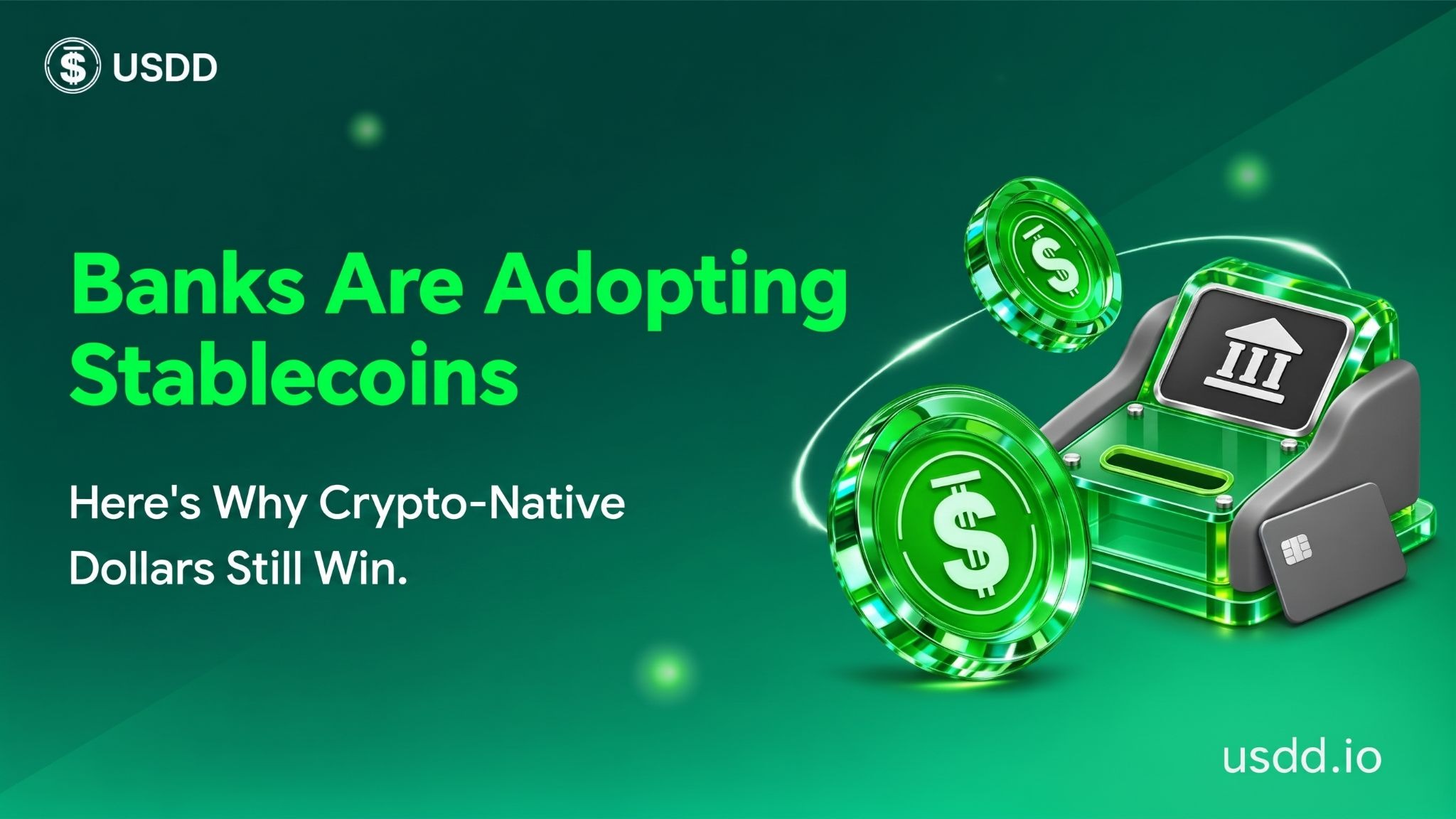
As traditional giants embrace digital dollars, USDD’s Yvonne Chia explains why self-custody, 24/7 transfers, and onchain yield give decentralized stablecoins an edge.
Commissioned byUSDD
November 20, 2026 – Traditional finance has officially woken up to stablecoins. Major commercial banks are piloting stablecoin settlement rails, while global banking consortia are committing hundreds of millions of dollars to launch their own digital tokens.
But as banks adopt blockchain infrastructure, one question remains: Are users gaining the benefits of crypto, or simply getting a faster version of traditional banking?
The value of crypto-native stablecoins lies in what users can do independently: hold their own assets, transfer money around the clock, access onchain opportunities, and verify how their assets are managed.
In an interview with ChangeNOW, USDD Head of Communications Yvonne Chia explains why decentralized alternatives offer a different model for digital finance.
1. Permissionless access vs. gatekept accounts
Opening a traditional bank account can involve paperwork, minimum balances, geographic restrictions, and approval delays. Even when banks introduce stablecoin services, access remains tied to institutional requirements and intermediaries.
Crypto-native stablecoins offer a different approach. As Yvonne Chia explained:
“Compare this to a stablecoin like USDD, where all you need is a phone, a working internet connection, you can immediately start a wallet and you have access to your funds right away.”
With USDD, users can manage digital dollars through their own wallets without relying on traditional financial intermediaries. They can choose where to hold, transfer, and use their assets across supported decentralized applications, gaining greater control over their financial decisions.
2. 24/7 global settlement vs. banking hours
Traditional payment networks remain constrained by banking hours, weekends, holidays, and cross-border settlement delays. Blockchain networks, by contrast, operate around the clock.
“We are able to have transfers 24/7 and we’re not limited to any traditional banking hours. So I think that in some ways, stablecoins are not just becoming banks, but exceeding what traditional banks can offer to users.”
USDD has also introduced GasFree integration on TRON, allowing users of supported wallets to pay transaction fees directly in USDD without holding TRX.
This removes an additional barrier to everyday transfers. Eligible users can pay approximately 0.5 USDD per transaction, compared with around 1.5 USDT for a standard USDT transfer under the referenced fee conditions.
Combined with 24/7 availability, lower transfer costs and simpler wallet experiences make stablecoins increasingly practical for everyday payments and global transfers.
3. Passing yield back to users vs. bank spreads
Another key difference lies in how yield reaches users. Traditional banks deploy customer deposits into yield-generating markets but retain much of the returns, while depositors often receive comparatively modest interest rates.
Stablecoins offer another way to participate in digital-dollar opportunities through decentralized protocols and onchain yield mechanisms.
USDD Earn makes these opportunities accessible to holders. Users can deposit USDD to receive sUSDD and earn competitive yield powered by the Smart Allocator system, without fixed lock-up periods.
This gives holders access to a productive stablecoin while retaining flexibility over their capital, rather than committing to conventional fixed-term deposit products.
4. Onchain verification vs. institutional trust
Traditional banking relies heavily on institutional disclosures and customer trust. USDD takes a different approach through its “Don’t trust, verify” ethos, making relevant information publicly accessible.
Its transparency framework includes:
Onchain transparency: Smart contract addresses, collateral reserves, and Smart Allocator deployments are publicly viewable.
Structured disclosures: Quarterly Treasury Reports provide information on reserves, financial performance, and operational developments.
Transparency does not eliminate financial or technical risks, but it gives users more ways to evaluate a protocol beyond relying solely on institutional assurances.
5. Beyond a single network: An open multichain ecosystem
Financial freedom also means using digital dollars across different networks and applications.
Following its January 2025 protocol upgrade, USDD expanded natively from TRON to Ethereum and BNB Chain, connecting with more blockchain communities, liquidity environments, and decentralized applications.
Its sUSDD product has also expanded into DeFi integrations, including Pendle and Morpho, providing additional ways to access yield strategies across supported ecosystems.
Together, these developments support an interconnected financial experience where users can hold, transfer, exchange, and deploy stablecoins according to their needs.
The future is open, interconnected, and multichain
Banks will continue adopting stablecoin infrastructure to modernize traditional settlement. But crypto-native stablecoins offer more than faster payments: greater control over assets, 24/7 transfers, access to onchain opportunities, and publicly verifiable information.
For USDD, the opportunity is to make digital dollars accessible, transferable, and productive across an interconnected financial ecosystem.
Banks may be bringing stablecoins into traditional finance. Crypto-native protocols are showing what stablecoins can make possible beyond it.
This publication is provided by the client. The text below is a paid press release that is not part of Cointelegraph independent editorial content. The text has undergone editorial review to ensure quality and relevance, it may not reflect the views and opinions of Cointelegraph. Readers are encouraged to conduct their own research before taking any actions related to the company. Disclosure.